

A solid routine for sensitive skin isn't about a 10-step process filled with trendy products. It’s actually much simpler. The real secret is consistency with gentle, minimalist products designed to do three things: cleanse, moisturize, and protect. This entire approach is built around strengthening your skin's natural barrier, not overwhelming it with a bunch of harsh, unnecessary ingredients.
What Does "Sensitive Skin" Really Mean?

Before we can build the right routine, we need to get on the same page about what "sensitive skin" actually is. It isn't a formal skin type like 'oily' or 'dry.' Think of it more as a condition—your skin is simply more prone to reacting to things. It just has a lower tolerance for stress.
Most of the time, this reactivity comes down to a compromised skin barrier. Your skin barrier is the outermost layer, and it’s your body's personal security guard against the outside world. When it's working properly, it keeps all the good stuff (like moisture) in and all the bad stuff (like irritants) out. But when it gets weakened, tiny cracks form, letting moisture escape and allowing allergens and pollutants to sneak in. That’s what leads to the classic signs of sensitivity: redness, stinging, and general discomfort.
Figuring Out Your Triggers
The first real step toward calm skin is identifying what sets it off. A lot of everyday things can throw a fragile skin barrier into a tailspin. Start paying close attention to how your skin feels after you encounter these common culprits:
- Hidden Fragrances: You'll often see these listed as "parfum" on an ingredient list. Synthetic scents are one of the biggest causes of skin reactions.
- Harsh Alcohols: Keep an eye out for ingredients like denatured alcohol or SD alcohol. They can strip your skin of its natural oils, leaving it dry and irritated.
- Environmental Stressors: Simple things like sun exposure, a windy day, or even just walking from a warm room into the cold can be enough to trigger a reaction.
- Over-Exfoliation: It's so easy to overdo it. Using rough physical scrubs or too many chemical exfoliants (like acids) can do serious damage to your skin barrier.
You're not alone in dealing with this. The demand for gentle solutions is huge—the global sensitive skin care products market was valued at around USD 44.36 billion and is only expected to grow. You can read the full research about the sensitive skin care market to see just how common this issue is.
An effective routine for sensitive skin isn't about adding more products. It’s about being incredibly selective and choosing fewer, better ones. The goal is to support your skin's natural healing process, not fight against it.
Ultimately, managing sensitive skin is all about learning to listen to what it needs. When you focus on minimalism, gentleness, and consistency, you give your skin the space it needs to heal and become stronger over time.
Your Gentle Morning Skincare Ritual

The morning sensitive skin care routine has one simple purpose: protect your skin for the day ahead. You don't want to cause irritation before you've even had your coffee. Since your skin is already relatively clean from the night before, less is absolutely more.
One of the quickest ways to damage a delicate skin barrier is by over-cleansing. This brings up a big question: do you even need to wash your face in the morning? Honestly, it depends entirely on your skin.
To Cleanse or Not to Cleanse
For a lot of people with reactive skin, a full-on cleanse first thing in the morning is just too stripping. It washes away all the beneficial oils your skin worked hard to produce overnight. If you wake up and your skin feels comfortable and balanced, just splashing it with lukewarm water is probably your best bet.
On the other hand, if you have oilier skin or tend to wake up feeling a bit greasy, a very gentle cleanse might feel better. The key is to skip anything that foams, as those cleansers are often too harsh. Look for a creamy, hydrating, and sulfate-free formula instead. The right choice is whatever leaves your skin feeling calm, not tight and squeaky. To learn more about gentle options, you can explore the benefits of a tallow face wash that respects your skin’s natural balance.
Layering Lightweight Hydration
Whether you just splashed with water or did a gentle cleanse, the next move is to add back a layer of soothing hydration. This is the perfect time for a simple, targeted serum. You aren't trying to do anything complicated here; the goal is just to calm and plump the skin.
Look for a serum with just a few key ingredients known to be gentle on sensitive skin:
- Hyaluronic Acid: A classic for a reason. This humectant pulls moisture into the skin, giving it a hydrated, bouncy feel without any heavy oils.
- Niacinamide (Vitamin B3): This is a true hero for sensitive complexions. Niacinamide helps calm redness, strengthen the skin barrier, and even manage oil.
- Glycerin: Another simple but powerful humectant that helps your skin grab onto water and stay hydrated all day.
Always apply a few drops to damp skin. This simple trick helps the serum absorb more effectively and locks in that moisture from your water splash. Just pat it in gently—no aggressive rubbing required.
Think of your morning routine as a defensive shield for your skin. Every step should be about calming, hydrating, and protecting. You're putting on armor, not scrubbing the castle walls.
Moisturize and Protect
Now for the two most critical steps in any morning routine: moisturizer and sunscreen.
First, lock everything in with a barrier-supporting moisturizer. My advice is to find a formula that contains ceramides, which are lipids that make up your skin’s natural barrier. A good moisturizer will seal in your serum and create a smooth, calm canvas.
The final, non-negotiable step is sunscreen. For sensitive skin, sun exposure is a major trigger that can lead to inflammation and redness. A mineral-based sunscreen with zinc oxide or titanium dioxide is usually the gentlest option, as the ingredients sit on top of your skin to physically block UV rays. Make sure you choose a broad-spectrum formula with at least SPF 30. Once that's on, your protective morning ritual is complete.
Your Restorative Evening Skincare Ritual
If your morning routine is all about defense, think of your evening ritual as your skin’s dedicated repair shift. This is your chance to gently wash away the day—sunscreen, makeup, city grime—and give your skin exactly what it needs to heal and rebuild while you sleep. The goal here is restoration, not aggressive treatments.
The whole process kicks off with the most important part of any routine: a really good, really gentle cleanse. For sensitive skin, a single wash often just doesn't cut it against stubborn SPF and makeup. But scrubbing harder? That's just asking for irritation. This is exactly why the double-cleansing method is such a game-changer.
The Art of the Double Cleanse
Double cleansing is a simple two-step process that literally melts away impurities without stripping your skin’s natural oils. It’s the best way to ensure you get everything off, creating a clean slate so your nighttime products can actually do their job.
-
First, an Oil-Based Cleanse: Start with an oil or a balm cleanser on dry skin. These formulas are made to dissolve other oils, so they break down sunscreen and makeup effortlessly. Gently massage it in for about a minute, and you’ll feel everything start to loosen up.
-
Next, a Water-Based Cleanse: After rinsing off the oil, follow up with a creamy, hydrating, water-based cleanser. This second step whisks away any leftover residue and cleans your skin itself. The key is to find a soap-free, pH-balanced formula that leaves your skin feeling soft and comfortable, never tight.
This one-two punch is incredibly effective because it cleans deeply without roughing up your delicate skin barrier. It’s one of the best habits you can build to prevent clogged pores and irritation from products that didn't get fully washed off.
Focus on Barrier Repair and Deep Nourishment
With your skin perfectly clean and prepped, it's time for the most restorative part of your evening. Nighttime is when you want to bring out a rich, reparative moisturizer loaded with ingredients that support your skin’s natural healing cycle. Your skin is most receptive to nourishment while you rest.
Here are a few powerhouse ingredients to look for in your evening moisturizer:
- Ceramides: Think of these as the "mortar" that holds your skin cells together. Applying them topically helps patch up any weak spots in your skin barrier.
- Glycerin: A true workhorse humectant. It pulls moisture from the air into your skin, keeping it hydrated and plump all night long.
- Colloidal Oatmeal: Famous for its incredible soothing properties, this ingredient is a go-to for calming redness and relieving that uncomfortable itchy feeling.
- Tallow: This traditional ingredient is packed with fatty acids and vitamins that are highly compatible with our skin's own biology. It provides deep, lasting nourishment and is fantastic for helping a compromised barrier get back on track. For a deeper dive, you can learn more about how to use tallow in your skincare.
Your evening routine is your opportunity to give back to your skin. By gently cleansing and deeply moisturizing, you create the optimal environment for your skin barrier to repair itself, leading to a calmer, happier complexion when you wake up.
Applying a generous layer of a good reparative moisturizer is the final, essential step. It seals in hydration and creates a protective cocoon, allowing your skin to focus all its energy on overnight recovery. This simple, calming ritual is the perfect way to end the day.
How To Choose Products And Read Labels
Building a routine that truly works for sensitive skin comes down to one thing: knowing what you're actually putting on your face. The marketing on the front of the bottle can promise miracles, but the truth is always in the fine print on the back—the ingredient list.
Learning to read those labels is probably the single most powerful thing you can do for your skin. It turns you from a hopeful shopper into a savvy advocate for your own complexion. You don't have to be a chemist, you just need to know the heroes from the villains.
The demand for gentle skincare is huge. In the U.S. alone, the market was valued at USD 8.07 billion and is expected to hit USD 13.94 billion by 2030. You can find more data on the sensitive skin care market over at Grand View Research. Clearly, a lot of us are searching for products that won't leave our skin red and angry.
Understanding The Ingredient List
Ingredient lists, often called the INCI list, are pretty straightforward: they're organized from the highest concentration to the lowest. The first five or six ingredients are the main players, making up the bulk of the product. This is where you want to see the good stuff—the calming, hydrating, barrier-supporting ingredients.
If you spot a known irritant high on that list, put the bottle back down. It's a major red flag. While ingredients further down the list are in smaller amounts, that doesn't always make them harmless, especially potent allergens like fragrance. When searching for cleansers, for instance, finding the best natural soap for sensitive skin usually means finding a short, simple list of ingredients you can actually recognize.
The goal isn't perfection. It's about playing the odds in your favor by systematically weeding out the most common troublemakers. You're looking for products with the highest chance of success for your skin.
The infographic below is a great cheat sheet, comparing some of the best ingredients for sensitive skin against the ones you should steer clear of.
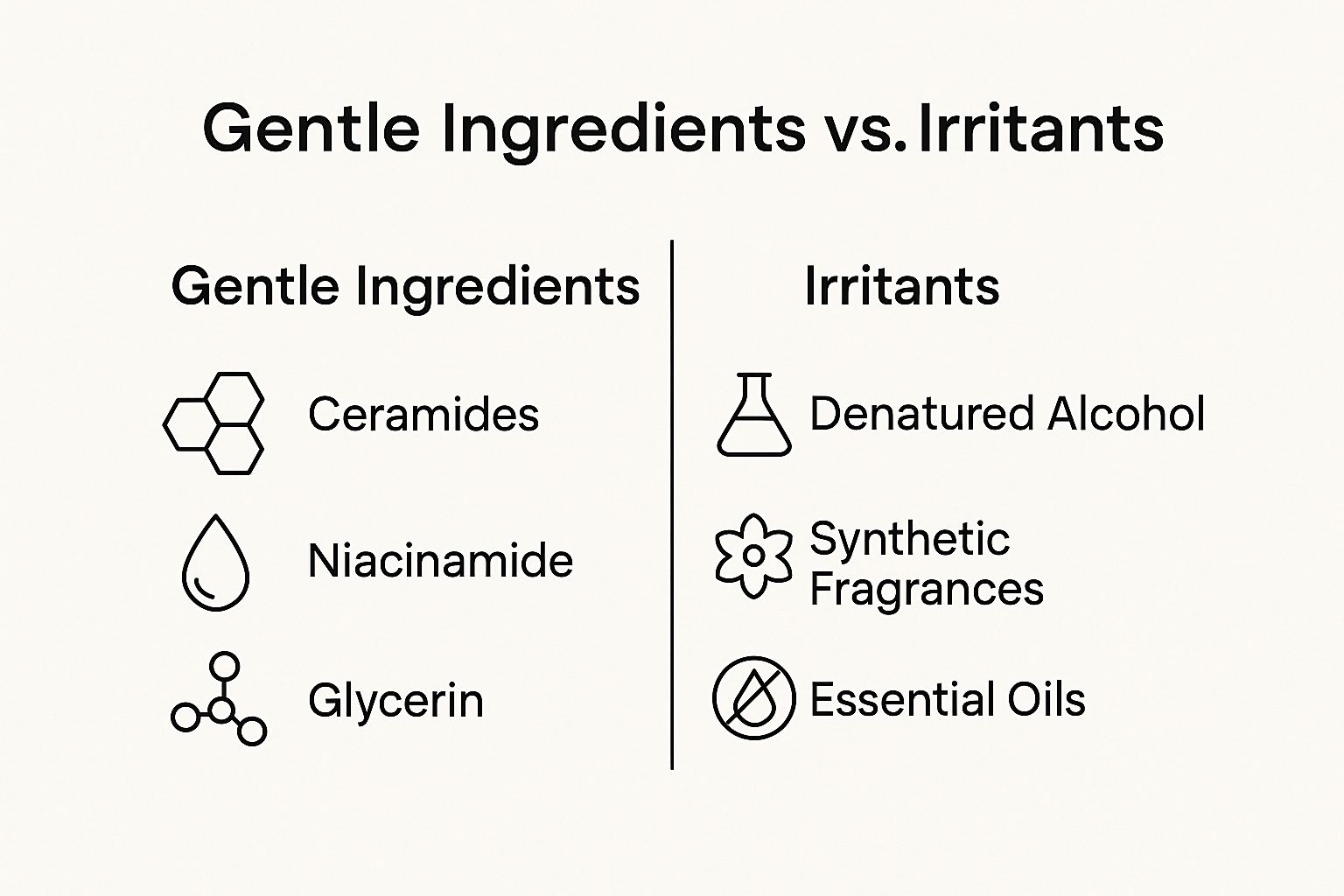
This visual is a handy shortcut, showing you what nourishes your skin barrier and what can tear it down.
To make things even clearer, I've put together a quick guide to some of the most common ingredients you'll run into.
Sensitive Skin Ingredient Guide: Safe Bets vs. Red Flags
| Ingredient Category | Safe Bets (Look for These) | Red Flags (Avoid These) |
|---|---|---|
| Moisturizers & Hydrators | Hyaluronic Acid, Glycerin, Ceramides, Squalane, Panthenol (B5) | Drying Alcohols (Denatured Alcohol, SD Alcohol), Mineral Oil |
| Soothers & Anti-Inflammatories | Niacinamide, Centella Asiatica (Cica), Green Tea Extract, Colloidal Oatmeal | Synthetic Fragrance/Parfum, Essential Oils (e.g., Lavender, Citrus) |
| Cleansers | Gentle Surfactants (Coco-Glucoside, Decyl Glucoside) | Sodium Lauryl Sulfate (SLS), Sodium Laureth Sulfate (SLES) |
| Exfoliants | Lactic Acid (in low concentrations), PHAs (Gluconolactone) | Glycolic Acid, Physical Scrubs (Walnut Shells, Apricot Pits) |
Think of this table as your shopping companion. Keeping these ingredients in mind will help you quickly filter products on the shelf and make choices that support your skin, not sabotage it.
The Non-Negotiable Patch Test
Even a product with a "perfect" ingredient list can cause a reaction. Our skin is unique, and you can never be 100% sure how it will respond to something new. That's why the patch test isn't just a suggestion—it's an absolute must. Think of it as your personal quality control.
Here’s how to do it right:
- Pick a Hidden Spot: Apply a tiny amount of the new product somewhere discreet, like just behind your ear or on the inside of your wrist. These areas are sensitive enough to react but won't be obvious if they do.
- Wait and Watch: Keep the area dry and leave the product alone for at least 24 to 48 hours.
- Check for Trouble: Look closely for any redness, itching, swelling, or small bumps.
If you see even a hint of irritation, that product is not for you. It can feel like a setback, but taking a few minutes to patch test can spare you from weeks of calming down a full-face flare-up. It's the smartest move you can make for happy, calm skin.
Lifestyle Habits That Calm Sensitive Skin

A solid sensitive skin care routine is your best defense, but what you do between applications plays a huge part in keeping your skin happy. Think of it this way: your lifestyle is the foundation your routine is built on. If that foundation is shaky, your skin will be the first to show the cracks.
So many everyday habits can secretly trigger redness and flare-ups. High stress levels, for example, flood your system with cortisol, an inflammatory hormone that can absolutely wreck a fragile skin barrier. The same goes for a diet heavy in processed sugar or dairy, which can kickstart inflammation that shows up right on your face.
This is why we're seeing such a massive shift in the beauty world. The global skin care market is on track to hit around USD 198.35 billion, and a huge slice of that is dedicated to sensitive skin products. More and more of us are finally connecting the dots between our overall health and our skin's behavior. You can discover more insights about the skincare industry on tricociuniversity.edu to see just how much this awareness is growing.
Smart Swaps for Happier Skin
You don't have to turn your life upside down overnight. Honestly, it's the small, consistent changes that add up to make the biggest difference in calming down reactive skin.
Let’s start with your immediate environment. Something as simple as your pillowcase can cause problems. The constant friction from a standard cotton case can easily aggravate sensitive skin while you sleep. A quick swap to a silk or satin pillowcase can dramatically reduce that friction, meaning less irritation and redness when you wake up.
Another easy win? Check your water temperature. I know a scalding hot shower can feel amazing, but it’s one of the fastest ways to strip your skin of its natural, protective oils. This leaves your moisture barrier weak and exposed. By sticking to lukewarm water—for both your face and body—you’re doing your skin a massive favor.
A holistic view is key. Your skin is just an outer reflection of your internal state and your environment. To calm your skin, you often have to start by calming your life.
Mindful Choices for Lasting Calm
Beyond your daily habits at home, what you put in your body is just as important. Loading up on anti-inflammatory foods can help soothe your skin from the inside out.
- Omega-3 Fatty Acids: Think salmon, walnuts, and flaxseeds. These powerhouse fats are crucial for reinforcing your skin's lipid barrier.
- Antioxidant-Rich Foods: Berries, dark leafy greens, and green tea are fantastic for fighting the oxidative stress that leads to inflammation.
- Probiotics: A happy gut often means happy skin. Foods like yogurt, kefir, and kimchi help balance your microbiome, which can have a direct, calming effect on your complexion.
And finally, stress management is completely non-negotiable. It doesn't have to be complicated. Whether it's five minutes of a mindfulness app, a brisk walk in the fresh air, or just a few deep breathing exercises at your desk, finding a way to decompress will pay off in calmer, more resilient skin.
A Few Common Questions About Sensitive Skin
Even the most carefully planned routine can leave you with questions. Dealing with flare-ups and trying new products is a journey, and having the right information makes it a whole lot easier. Let's tackle some of the things people wonder about most.
The biggest hurdle for almost everyone? Patience. It's so tempting to want a perfectly calm complexion overnight, but real, lasting change happens deep down.
How Long Does It Take to See Results?
This is where you have to play the long game. While a great moisturizer can feel soothing right away, it typically takes a solid 4 to 6 weeks of consistent use to really notice a difference in your skin's overall health and strength.
Why so long? That's about how much time your skin needs to complete a full cell turnover cycle. It’s also why constantly jumping between new products can do more harm than good. Give your gentle routine a fair chance to work its magic.
Can I Still Use Actives Like Retinoids or Acids?
Yes, but with a big dose of caution. Your number one goal is always a healthy, intact skin barrier. Don't even think about adding actives until your skin has been consistently calm and happy for several months.
When you're ready, start slow and low.
- Polyhydroxy Acids (PHAs) are a great starting point. Ingredients like gluconolactone have a larger molecule size, so they don't sink in as deep and are much gentler than their AHA or BHA cousins.
- Granactive retinoids are a newer form of retinoid specifically designed to be less irritating than traditional retinol.
Introduce just one new active, and only use it once or twice a week to start. Watch your skin closely. If you see any redness or feel any stinging, stop immediately. Honestly, for many of us with sensitive skin, a simple, supportive routine without any strong actives is all we really need.
What’s the Difference Between "Fragrance-Free" and "Unscented"?
This is a huge one, and the distinction is critical for avoiding irritation.
Fragrance-Free: This is your gold standard. It means zero fragrances—natural or synthetic—have been added. No essential oils, no parfum, nothing.
Unscented: This label can be tricky. It usually means a chemical has been added to mask the natural scent of the other ingredients. That masking agent can be a major irritant itself. Always choose fragrance-free.
My Skin Suddenly Became Sensitive! What Do I Do?
When your skin suddenly freaks out, the best response is to strip everything back to the absolute basics. Think of it as a reset.
Stop all actives, exfoliants, and masks. For the next couple of weeks, commit to a "skin diet" of just three things: a gentle, creamy cleanser, a simple barrier-supporting moisturizer, and a mineral sunscreen. This approach removes all potential triggers and gives your skin the quiet space it needs to heal. If the sensitivity doesn't calm down, it's time to check in with a dermatologist.
Ready for a truly minimalist approach? The formulas from Wild Tallow Skincare use just 3 food-grade ingredients to calm and nourish even the most reactive skin, with absolutely no hidden irritants. Discover simple skincare at Wild Tallow.