

When it comes to sensitive skin, the best ingredients are the ones your skin already knows and loves. We’re talking about biocompatible and barrier-supporting options that feel like coming home. Think simple, food-grade ingredients like grass-fed tallow, olive oil, and beeswax.
These ingredients are brilliant because they closely mimic the natural oils your skin produces. Add in some calming botanicals like aloe vera or chamomile, and you have a recipe for happy, peaceful skin. The secret is choosing things your skin can easily recognize and put to good use.
Your Quick Guide to Calming Sensitive Skin
If you have sensitive skin, you know the routine. It's like having a very particular friend—one wrong move, and you're left dealing with redness, itching, and general unhappiness for days. But you’re definitely not alone.
Believe it or not, around 50% of people worldwide are in the same boat, waking up to skin that seems to react to everything from the weather to a new laundry detergent. It's an even more common story for women, with studies showing about 60% report having sensitive skin compared to 40% of men. This is exactly why simple, fragrance-free formulas are finally getting the spotlight they deserve. You can read more about the shift toward gentle skincare solutions to see how the industry is catching up.
Understanding Your Skin's Needs
Think of "biocompatibility" like this: you're serving your skin a meal it was born to eat. When an ingredient is biocompatible, your skin doesn’t see it as a foreign invader. It recognizes it, welcomes it in, and knows exactly how to use it for nourishment and repair.
This is precisely why natural fats like grass-fed tallow work so beautifully. Its fatty acid profile is incredibly similar to our skin’s own sebum, making it a near-perfect match. This beautiful synergy helps rebuild and fortify your skin's natural barrier—that all-important shield that keeps the good stuff (like moisture) in and the bad stuff (like irritants) out.
A healthy skin barrier is your first and best line of defense against sensitivity. Choosing ingredients that repair and support this barrier is the most direct path to consistently calm skin.
When your barrier is strong, your skin is resilient. When it's weak, it’s an open invitation for chaos.
To make this crystal clear, let's sort the heroes from the villains. Reading an ingredient label shouldn't feel like you're trying to crack a code. The table below is a simple guide to help you spot what to look for—and what to run from. Think of this "Calm vs. Chaos" list as your personal cheat sheet for smarter, safer skincare choices.
Quick Guide: Calm vs. Chaos Ingredients for Sensitive Skin
This handy table breaks down the good, the bad, and the ugly in skincare ingredients. Keep these in mind next time you're shopping.
| Ingredient Category | Calm Ingredients (Your Skin's Best Friends) | Chaos Ingredients (Potential Irritants to Avoid) |
|---|---|---|
| Moisturizers & Fats | Grass-Fed Tallow, Shea Butter, Olive Oil, Ceramides | Mineral Oil, Petrolatum, Certain Synthetic Emollients |
| Cleansers | Gentle, Soap-Free Cleansers, Oil-Based Cleansers | Sodium Lauryl Sulfate (SLS), Sodium Laureth Sulfate (SLES) |
| Soothing Agents | Aloe Vera, Chamomile, Calendula, Colloidal Oatmeal | Synthetic Fragrances, Perfumes, Masking Agents |
| Preservatives & Alcohols | Natural Preservatives (e.g., Vitamin E) | Drying Alcohols (e.g., SD Alcohol, Denatured Alcohol), Parabens |
Simply put, sticking to the "Calm" column is your best bet for keeping your skin happy and avoiding unnecessary flare-ups. The more you learn to spot the troublemakers in the "Chaos" column, the more empowered you'll be.
Why Your Skin Barrier Is Your Best Defense
Think of your skin as a sturdy brick wall. This wall, which scientists call the skin barrier (or stratum corneum), is your body’s frontline defense against everything the world throws at it. It’s the bouncer at the door, deciding what gets in and what stays out, and it's the single most important factor in keeping your skin hydrated, calm, and healthy.
The structure is actually pretty straightforward. Your skin cells (corneocytes) are the "bricks," and a fatty, lipid-rich mixture acts as the "mortar" holding them together. This mortar is made up of ceramides, cholesterol, and fatty acids, creating a tough, resilient seal.
The Gatekeeper of Your Skin
When your skin barrier is healthy and intact, it does two critical jobs without you ever noticing. First, it locks moisture in, preventing what’s known as transepidermal water loss (TEWL)—the culprit behind dry, flaky, and uncomfortably tight skin. Second, it blocks external troublemakers like pollution, allergens, and bacteria from getting into the deeper layers of your skin and causing a fuss.
But when that barrier gets damaged, it’s like having cracks in the mortar. Moisture evaporates right out, and irritants can easily slip through the gaps. This is the real reason behind almost every symptom we blame on "sensitive skin," from redness and itching to stinging and chronic inflammation.
This visual really breaks it down, showing the two roads your skin can go down: one leading to a calm, supported barrier, and the other to irritation and chaos.
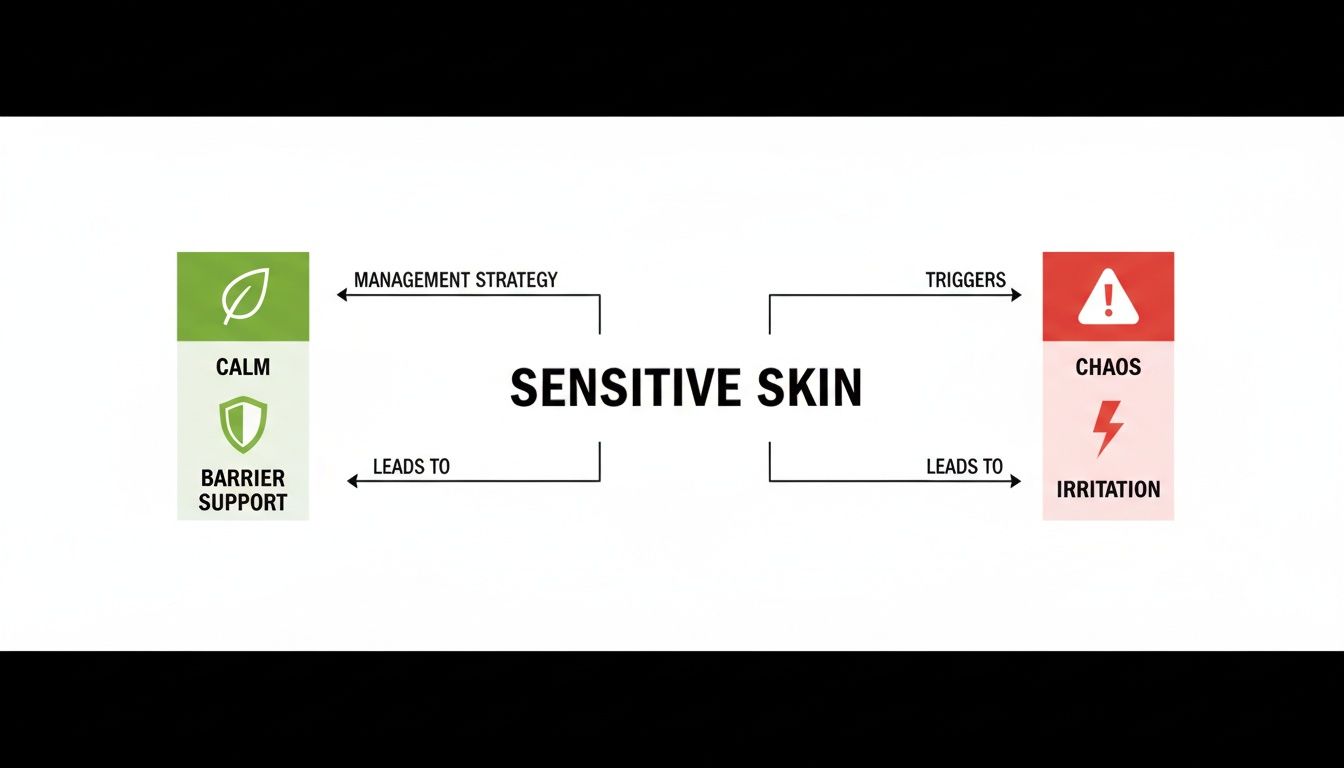
The takeaway is simple: supporting your barrier is the direct path to calm, resilient skin. If you neglect it, you’re leaving the door wide open for irritation.
Rebuilding Your Natural Defenses
So, how do you patch up those cracks in the wall? The secret is to give your skin ingredients that replenish the "mortar" it's missing. This is where biocompatibility is everything. Your skin is incredibly smart; it knows how to recognize and use fats and lipids that are almost identical to its own.
The most effective way to manage sensitive skin isn't just about soothing symptoms—it's about rebuilding the barrier itself. When you give your skin the right building blocks, you empower it to do its own repair work.
This is exactly why some of the best ingredients for sensitive skin are often the simplest. They aren't cooked up in a lab but are found in nature, offering the exact fatty acids and lipids your skin is desperate for. When you shift your focus to barrier repair, you stop chasing temporary fixes and start building long-term skin health.
If you want to go deeper on this, our guide on how to repair a damaged skin barrier walks you through the actionable steps.
Ingredients That Act Like Mortar
To effectively rebuild your skin's defenses, you need ingredients that can slip right into its structure, just like using the perfect patch material for our brick wall. Here are the types of ingredients that get the job done:
- Biocompatible Fats: Lipids that are a near-perfect match for your skin's own natural oils, like those in grass-fed tallow, are welcomed with open arms and put to work immediately.
- Occlusive Agents: These ingredients create a protective, breathable film over your skin. This simple layer locks in moisture and gives your barrier the time and space it needs to heal itself. Beeswax is a fantastic natural example.
- Nourishing Oils: Full of essential fatty acids and antioxidants, oils like high-quality olive oil deliver a one-two punch of hydration and protection from the environmental stressors that weaken the barrier.
By choosing products made with these kinds of barrier-loving ingredients, you're actively helping your skin become stronger from the inside out. It's a proactive strategy that lays the foundation for consistently calm, comfortable, and healthy skin.
The Top Ingredients That Soothe Sensitive Skin
When your skin feels like it's constantly on high alert, the answer isn't a complicated, 10-step routine. It’s about getting back to basics with simple, powerful ingredients your skin already knows and understands. These are the ingredients that work with your skin's biology, not against it, to soothe, nourish, and rebuild from the ground up.
For sensitive skin, less is always more. This is where a minimalist, food-grade approach really shines. We’re talking about ingredients so pure you could literally eat them. Let's dive into three of the most effective and gentle powerhouses: grass-fed tallow, olive oil, and beeswax.
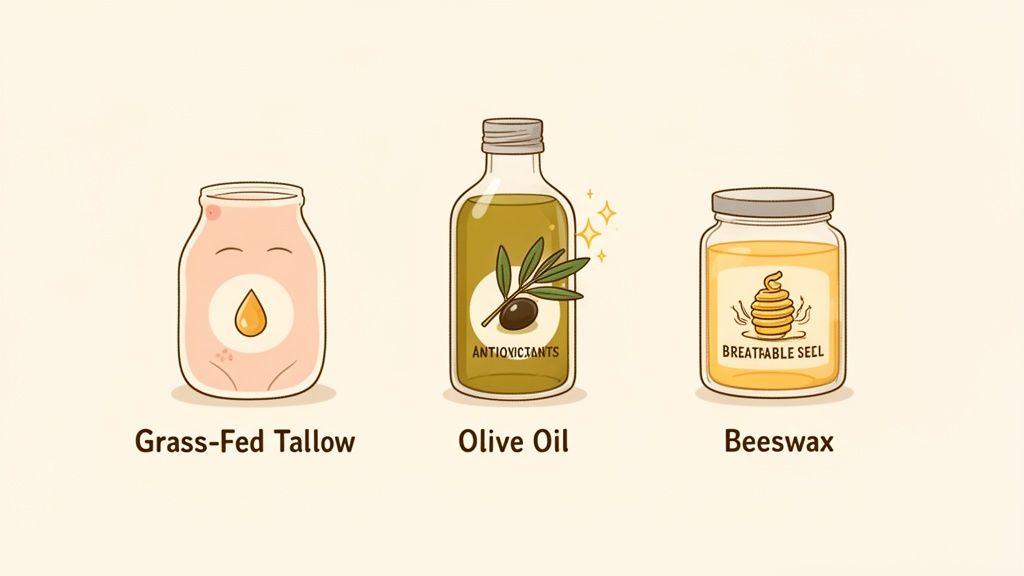
Grass-Fed Tallow: The Ultimate Skin Food
Imagine an ingredient so perfectly matched to your skin’s makeup that it’s absorbed almost instantly, leaving nothing behind but calm, supple comfort. That’s the magic of grass-fed tallow. This traditional fat, rendered from suet, is a true nutritional powerhouse for skin, and its secret lies in its remarkable similarity to our own biology.
Tallow is rich in the very same kinds of fats and lipids found in healthy, resilient skin. Its fatty acid profile—including oleic, palmitic, and stearic acids—is a near-perfect mirror of our skin's natural sebum. Think of it like giving your skin a meal it was designed to digest. Because your skin recognizes it, it doesn't trigger a defense response; it simply welcomes the nutrients in to start repairing the skin barrier.
Tallow acts like a key fitting perfectly into a lock. Its biocompatible structure allows it to deliver fat-soluble vitamins like A, D, E, and K directly where they're needed, promoting cell regeneration and calming inflammation from within.
On top of that, grass-fed tallow is packed with conjugated linoleic acid (CLA), which has powerful natural anti-inflammatory properties. This makes it incredibly effective for calming conditions like eczema, rosacea, and general redness, offering a kind of relief that synthetic ingredients often can't match.
Olive Oil: Ancient Moisture and Antioxidant Power
Olive oil isn't just a kitchen staple; it's one of history’s most celebrated skincare ingredients for a reason. Its benefits for sensitive skin are huge, mostly thanks to its high concentration of oleic acid and potent antioxidants.
Sensitive skin is a widespread issue, now affecting about half the world's population. This has pushed the sensitive skincare market from USD 44.36 billion to USD 48.42 billion in just one year. Here in North America, where environmental stressors and genetics play a big role, people are desperately looking for natural solutions that actually work. That's where olive oil comes in. Its oleic acid content helps it mesh with the skin’s lipids, and some studies have shown it can reduce water loss by up to 20-30% in sensitive skin. You can read more in this sensitive skin care market growth analysis.
This ability to lock in moisture is critical for repairing a broken skin barrier. But olive oil does more than just hydrate. It’s also loaded with antioxidants like polyphenols and vitamin E. These compounds are like personal bodyguards for your skin, neutralizing the free radicals from UV rays and pollution that weaken your skin’s defenses.
When it comes to sensitive skin, always opt for a high-quality, cold-pressed olive oil. This ensures it holds onto its full nutritional value, delivering a soothing, protective dose of moisture without any irritation.
Beeswax: The Breathable Barrier Protector
The final hero in our minimalist lineup is beeswax—nature’s perfect sealant. If tallow provides the building blocks and olive oil delivers the deep moisture, then beeswax is the gentle guardian that locks it all in place. Its unique structure is what makes it so special for sensitive skin.
Unlike petroleum-based ingredients that can suffocate the skin and clog pores, beeswax forms a protective—but completely breathable—layer. This film does two crucial jobs:
- It Locks in Moisture: By creating a delicate seal over the skin, beeswax dramatically reduces transepidermal water loss, keeping your skin hydrated and happy for much longer.
- It Shields from Irritants: This same barrier helps protect your skin from environmental troublemakers like wind, cold air, and pollutants, all without getting in the way of your skin's normal functions.
Beeswax is also a natural humectant, which means it actually draws moisture from the air toward your skin, giving you an extra hydration boost. It's naturally anti-inflammatory and antibacterial, making it a fantastic choice for skin that's prone to irritation. It provides lasting protection without feeling heavy or greasy, truly rounding out this powerful, skin-loving trio.
Common Irritants You Should Always Avoid
Knowing what to put on your sensitive skin is only half the battle. Just as crucial is knowing what to keep far, far away. Some of the most common ingredients in skincare are like sparks in a dry forest for sensitive complexions, triggering the redness, itching, and irritation that can set your skin barrier back for weeks.
The best defense you have is becoming a confident label-reader. Think of it this way: your sensitive skin has a very small circle of trusted friends. When you introduce a chaotic, unpredictable ingredient, it immediately sounds the alarm. Let's go through the main culprits you'll want to spot and avoid.
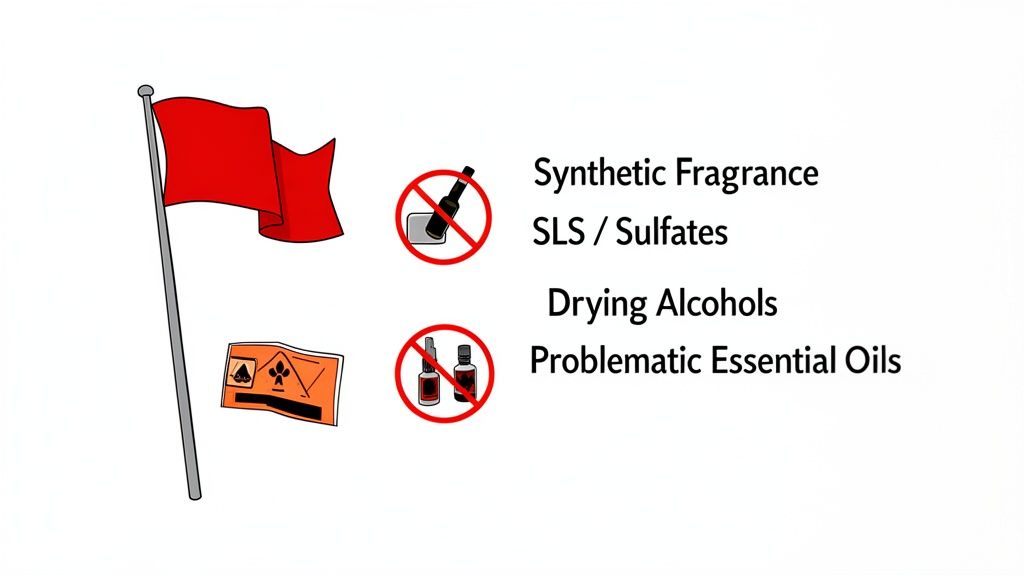
Synthetic Fragrances: The Number One Offender
If you only take one piece of advice from this entire guide, make it this one: avoid synthetic fragrances at all costs. That lovely scent in a lotion might seem harmless, but the word "fragrance" or "parfum" on an ingredient list is a Trojan horse. It's a legal loophole that allows companies to hide a cocktail of hundreds of undisclosed chemicals, many of which are known allergens.
These chemical mixtures are a top cause of contact dermatitis—the very flare-ups you’re trying to prevent. Your skin simply doesn't recognize these artificial compounds and launches an inflammatory response to protect itself.
Expert Tip: Always choose "fragrance-free" over "unscented." Unscented products often use masking fragrances to cover up the chemical smell of other ingredients. Fragrance-free, on the other hand, means no scents have been added at all.
This isn’t just a niche concern. Fragrance-free claims now appear on 57.6% of products in the massive USD 10.4 billion sensitive skincare market. Why? Because people are realizing that allergens can be the trigger for up to 80% of skin irritations. It's also why an ingredient like beeswax is so great—it helps form a protective layer that can boost moisture retention by 25-40% without any synthetic additives.
Harsh Sulfates and Drying Alcohols
Next on the list are two ingredients notorious for stripping your skin of its natural, protective oils: sulfates and drying alcohols.
-
Sulfates (SLS & SLES): You'll find Sodium Lauryl Sulfate (SLS) and Sodium Laureth Sulfate (SLES) in many cleansers and soaps. They're aggressive detergents responsible for creating that rich, bubbly lather. While it feels satisfying, that foam comes at a steep price. These surfactants are so powerful that they wash away your skin's precious lipids, leaving your barrier compromised, tight, and vulnerable.
-
Drying Alcohols: Keep an eye out for names like SD alcohol, denatured alcohol, or isopropyl alcohol high up on an ingredient list. These are often used to make a heavy cream feel light or help other ingredients absorb better. The problem is, they evaporate almost instantly and take your skin's moisture with them, leading to long-term dryness and irritation.
It’s worth noting that not all alcohols are bad guys. Fatty alcohols, like cetyl and stearyl alcohol, are completely different—they're non-irritating and actually help moisturize the skin. The trick is learning to spot the harsh, drying types and steer clear.
Certain Essential Oils and Abrasive Exfoliants
Even "natural" doesn't always mean "gentle." While many botanicals are wonderfully soothing, some essential oils are incredibly potent and can be major irritants for reactive skin.
Potent oils like peppermint, citrus oils (lemon, orange, bergamot), and even tea tree oil can be too intense, causing redness and sensitization. While they have benefits for some skin types, they're often too risky for a truly sensitive complexion. For a more comprehensive rundown, check out our guide on skin care ingredients to avoid.
Finally, avoid harsh physical exfoliants like crushed nut shells or large sugar crystals. These can create micro-tears in your delicate skin barrier, inviting inflammation and making sensitivity even worse. The goal is always to soothe and support, never to strip or abrade.
How to Read Labels and Patch Test New Products
Knowing which ingredients your skin loves—and which it hates—is a great start. But the real test happens when you're standing in a store, bottle in hand, trying to decide if a new product is friend or foe. Learning to confidently read a skincare label is probably the single most important skill you can build to keep your sensitive skin happy.
Ingredient lists, officially called the INCI (International Nomenclature of Cosmetic Ingredients), can look like a foreign language. Don't let them intimidate you. The most important thing to know is that ingredients are always listed from the highest concentration to the lowest. Those first five or six ingredients? That's the vast majority of what's in the bottle, so they deserve your full attention.
Decoding the Ingredient List
When you pick up a product, your first mission is to spot the good guys and the bad guys. Look for those calming, skin-friendly ingredients we talked about earlier—like tallow (Adeps Bovis), olive oil (Olea Europaea Fruit Oil), and beeswax (Cera Alba)—right at the top.
At the same time, keep an eye out for common culprits. If you see "Fragrance/Parfum," harsh sulfates, or drying alcohols high on that list, it's a pretty clear signal to put it back on the shelf. This logic applies to anything that touches your skin for a long time; it's why experts always recommend looking for hypoallergenic materials for skin contact to prevent problems before they start.
When it comes to sensitive skin, the "less is more" philosophy is your superpower. A shorter ingredient list means fewer variables and a dramatically lower chance of a flare-up.
Formulas with just a handful of high-quality, recognizable ingredients are always the safest choice. It's easy to know exactly what you're putting on your body, which is a cornerstone of truly safe, chemical-free skincare products.
Mastering the Art of the Patch Test
Okay, so you found a product with a beautifully simple, clean ingredient list. You still need to do one more thing before slathering it on: the patch test. Think of it as your final safety check. Everyone's skin chemistry is different, and this simple step is your best defense against a widespread reaction. It's a non-negotiable for anyone with easily irritated skin.
Here’s how to do it right:
- Choose a Discreet Spot: Find a small patch of skin that's both sensitive and out of the way. The inside of your wrist, behind your ear, or the crook of your elbow are all perfect spots.
- Apply and Wait: Dab a small amount of the product onto the area. If it's a wash-off product, follow the directions just as you normally would. Otherwise, just leave it on.
- Observe for 24-48 Hours: This is the crucial part. Don't use the product anywhere else while you wait. You're giving your skin time to show you if there's a problem.
- Look for a Reaction: Keep an eye on the spot. Are you seeing any redness, itching, swelling, stinging, or little bumps? If you notice any of these signs, gently wash the area and stop using the product immediately.
If the skin is still calm, clear, and happy after 48 hours, you can feel confident welcoming that new product into your routine. A couple of days of patience is a tiny price to pay for long-term skin peace.
Putting It All Together: Your Simple, Effective Skincare Routine
After sorting through the heroes and villains of the skincare world, one thing becomes crystal clear: the secret to happy skin isn't about more products. It's about the right ones. The most incredible results often come from stripping things back and building a routine around a few powerhouse ingredients your skin can actually recognize and use.
This isn't just about avoiding what’s bad; it's about actively giving your skin what’s good. When you use formulas built around ingredients like grass-fed tallow, olive oil, and beeswax, you're providing the fundamental building blocks your skin needs to repair its barrier and find its equilibrium. Once you get comfortable with these core ingredients, you can build the perfect skincare routine for sensitive skin that feels just right for you.
The "Less Is More" Advantage
A pared-down routine centered on one high-quality, do-it-all product can be a game-changer. Think about swapping out a separate cleanser, serum, and moisturizer for a single, nourishing tallow balm. The benefits are immediate and profound.
- Drastically Reduces Irritation Risk: Every ingredient you add is another lottery ticket for a potential reaction. Fewer ingredients mean you stack the odds in your favor.
- Saves Time and Money: A simple routine clears up your counter space and your budget. No more half-used bottles and wasted money.
- Strengthens the Skin Barrier: Consistently using biocompatible ingredients gives your skin the support it needs to grow stronger and more resilient all on its own.
This approach is a lifesaver for families, too. A single, pure tallow cream can be a daily face moisturizer for you, a gentle balm for a baby’s delicate bottom, and a go-to for soothing dry patches or eczema flare-ups for everyone in the house.
The ultimate goal is peace of mind. A simple, transparent routine means you can feel truly confident and in control of what you're putting on your body and your family's.
What This Looks Like in Real Life
Let’s make this practical. Instead of a complicated morning ritual, you could just splash your face with warm water and then massage in a small amount of whipped tallow cream. That's it. The tallow provides deep moisture, the olive oil delivers antioxidants, and the beeswax creates a breathable seal to protect you all day.
Come evening, you can use that very same product to gently melt away makeup and grime before applying a slightly thicker layer to nourish your skin overnight. This isn't about deprivation—it’s about finding a product so effective and versatile that it makes a 10-step routine feel completely unnecessary. It’s a return to an intuitive way of caring for ourselves, one that listens to our skin and gives it the simple, honest nourishment it’s been craving.
Your Sensitive Skin Questions, Answered
When you're dealing with reactive skin, it feels like you have a million questions. It's totally normal. Let's walk through some of the most common ones so you can feel confident about the choices you're making for your skin.
Are All "Natural" Ingredients Automatically Safe for Sensitive Skin?
That's a common misconception, and the answer is a definite no. Think of it this way: poison ivy is natural, but you wouldn't want it anywhere near your skin! Many potent natural ingredients, like certain essential oils or citrus extracts, can be major irritants.
The goal isn't just to find natural ingredients, but biocompatible ones—ingredients your skin recognizes and works with. Grass-fed tallow is a perfect example because its fatty acid profile is incredibly close to our own skin's oils. But as with anything new, natural or not, always patch test first.
Why Is a Shorter Ingredient List So Much Better?
It really comes down to simple math. Every ingredient in a product is a potential trigger for irritation. The more things you have in the bottle, the higher the odds that one of them won't agree with your skin.
When you stick to minimalist formulas with just a handful of high-quality ingredients, you take back control. It's easier to pinpoint what your skin loves and, just as importantly, what it doesn't. This is about getting powerful results through transparency, not a chemical cocktail.
If a reaction does happen, troubleshooting is a breeze. You're not left guessing which of the 50 ingredients on the label is the culprit.
I Have Acne-Prone Skin. Can I Really Use Tallow?
Yes, absolutely. It might sound counterintuitive to put a fat on acne-prone skin, but many people find it works wonders. Because grass-fed tallow's lipid profile is so similar to our skin's sebum, it can actually help balance your own oil production rather than clogging pores.
For the vast majority of people, tallow is non-comedogenic. Of course, everyone's skin has its own personality, so the golden rule still applies: do a small patch test on an acne-prone area first to see how your skin responds.
Ready for a skincare routine you can finally trust? At Wild Tallow Skincare, we believe in the power of simplicity. Our products are made with just three food-grade ingredients, delivering honest nourishment that’s perfect for the whole family. Discover our gentle, effective formulas today.