

Ever feel like you’re doing everything right with your skincare routine, yet new breakouts keep showing up? The culprit might be hiding in plain sight on your product labels. A comprehensive pore clogging ingredients list often features usual suspects like coconut oil, cocoa butter, and certain lanolins, which are notorious for causing blockages.
These ingredients, known as comedogenics, are common triggers for acne, blackheads, and whiteheads. Getting to know them is the first real step toward achieving consistently clearer skin.
What Are Pore Clogging Ingredients and Why Do They Matter?
Let's break it down. Think of your pores as tiny, microscopic pipes. In healthy skin, your natural oil (sebum) and dead skin cells flow up and out of these pipes without a hitch. It's a smooth, self-cleaning operation.
But some ingredients are like thick, sticky gunk. They get into those pipes and mix with your sebum and dead cells, creating a stubborn plug. This blockage is the perfect breeding ground for bacteria, which leads directly to the issues we all dread:
- Blackheads: These are open plugs right at the skin's surface that turn dark when they hit the air.
- Whiteheads: These are closed plugs that form a small bump just beneath the skin.
- Acne Pimples: This is what happens when bacteria throw a party in that clogged pore, causing inflammation, redness, and pain.
Introducing the Comedogenic Scale
To help us navigate the confusing world of ingredient lists, scientists came up with the comedogenic scale. It’s a handy rating system that ranks ingredients based on how likely they are to clog pores.
The scale runs from 0 to 5. A rating of 0 means an ingredient is completely non-comedogenic (it won't clog pores at all), while a 5 means it has a very high chance of causing a blockage.
This little scale is your secret weapon for decoding product labels. It’s a simple, straightforward way to understand what you’re really putting on your skin.
Before we dive into the specific ingredients to watch out for, here’s a quick reference table to help you get familiar with what those numbers actually mean for your skin type.
The Comedogenic Rating Scale Explained
| Rating | Likelihood to Clog Pores | Best For Which Skin Type |
|---|---|---|
| 0 | Will not clog pores | All skin types, including the most sensitive and acne-prone. |
| 1 | Very low likelihood | Generally safe for most skin types. |
| 2 | Moderately low likelihood | Mostly fine for normal and dry skin, but proceed with caution if you're very acne-prone. |
| 3 | Moderate likelihood | Best to avoid on the face if you have oily or acne-prone skin. Often okay for the body. |
| 4 | Fairly high likelihood | A major red flag for anyone prone to breakouts. Avoid this on your face. |
| 5 | High likelihood of clogging pores | Steer clear! This is almost guaranteed to cause issues for most people. |
Understanding this rating system empowers you to move past marketing hype and focus on the formulation itself. Instead of guessing, you can start pinpointing potential triggers and build a routine that actually keeps your skin happy and clear.
Alright, you've got the basics of the comedogenic scale down. Now, let's meet the main culprits—the ingredients that are almost guaranteed to cause trouble.
This is your official "steer clear" list. We're zeroing in on ingredients that score a notorious 4 or 5 on the scale. These are the ones most likely to create those deep, stubborn clogs, especially if you have oily or acne-prone skin.
Think of these ingredients as roadblocks for your pores. Their texture is often thick, heavy, or just plain sticky. This means your skin's natural oils (sebum) and dead skin cells can't get out. Everything gets trapped, turning your pores into the perfect breeding ground for blackheads and pimples.
To make it easy to visualize, here's a simple breakdown of the comedogenic scale, from the safest ingredients to the highest-risk offenders.
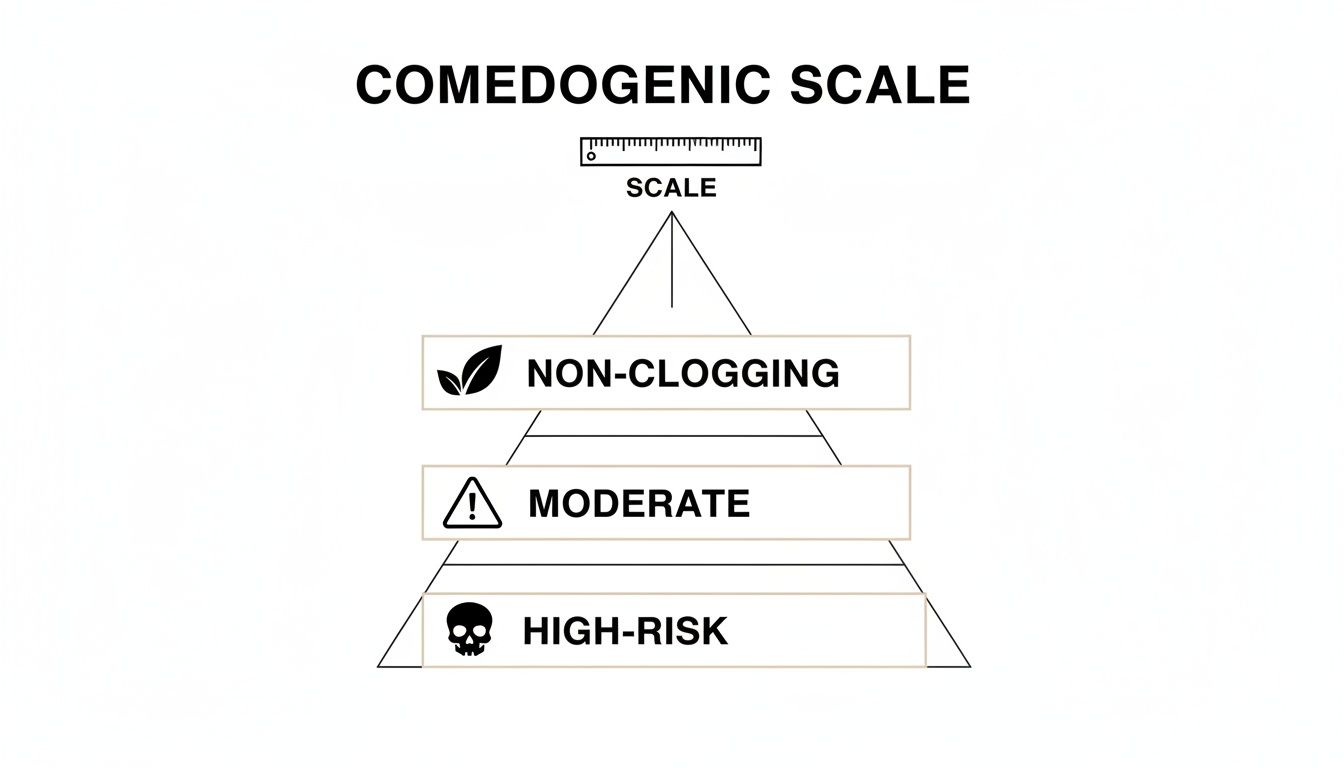
This little pyramid is a great mental shortcut. You want to live in the green zone at the bottom and be extremely cautious about anything in that red "high-risk" peak.
So, let's get specific and name names.
Here’s a quick-reference table of the Top 10 High-Risk Pore Clogging Ingredients to Avoid. These are some of the most common offenders you'll see on ingredient labels. Pin this list, screenshot it—do whatever you need to do to remember them when you're shopping.
| Ingredient Name | Comedogenic Rating | Commonly Found In |
|---|---|---|
| Coconut Oil | 4-5 | Facial oils, moisturizers, "natural" cleansers |
| Cocoa Butter | 4 | Rich creams, body butters, lip balms |
| Wheat Germ Oil | 5 | Anti-aging serums, heavy moisturizers |
| Palm Oil | 4-5 | Soaps, lotions, various cosmetic products |
| Isopropyl Myristate | 5 | Foundations, primers, silky-feeling serums |
| Isopropyl Palmitate | 4 | Thickeners in creams and lotions |
| Ethylhexyl Palmitate | 4 | Silicone-free primers, foundations, sunscreens |
| Laureth-4 | 5 | Lotions, cleansers (as an emulsifier) |
| Myristyl Myristate | 5 | Rich moisturizers, thick foundation sticks |
| Acetylated Lanolin | 4-5 | Heavy creams, ointments, lip products |
Remember, seeing any of these high on an ingredient list is a major red flag, especially if you're prone to breakouts.
The Big Four: Notorious Oils and Butters
You'd think all-natural oils and butters would be good for you, right? Not always. Some are fantastic, but a few are like pouring cement into your pores. They are often incredibly rich and "occlusive," which means they form a heavy, suffocating barrier on the skin.
- Coconut Oil (Rating 4-5): This one is controversial. It's hailed as a miracle ingredient in many circles, but for facial skin, it's often a disaster. It’s incredibly thick and has a fatty acid profile that leads to serious congestion for many people.
- Cocoa Butter (Rating 4): Wonderful for moisturizing your body from the neck down, but its dense, waxy nature makes it a huge "no" for the face. Keep it in your body lotion, not your face cream.
- Wheat Germ Oil (Rating 5): This is one of the heaviest hitters on the list. It’s a thick, sticky oil that provides intense moisture but is almost guaranteed to cause blockages if your skin is even remotely reactive.
- Palm Oil (Rating 4-5): Much like coconut oil, palm oil is high in fatty acids that easily clog pores. It’s a common, inexpensive ingredient in soaps and lotions, so keep an eye out for it.
Sneaky Synthetics and Fatty Acids
It's not just the natural stuff you have to worry about. A lot of lab-made ingredients designed to make products feel smooth and luxurious are actually some of the worst pore-cloggers out there.
Isopropyl Myristate (Rating 5): This is one of the most infamous comedogenic ingredients. It's an ester used as a penetration enhancer, meaning it helps other ingredients sink into your skin. Unfortunately, it often clogs the very pathways it opens up.
Another one to watch for is Laureth-4 (Rating 5). It’s an emulsifier that helps blend oil and water, giving lotions that elegant, uniform texture. While it feels nice, it's a top-tier pore-clogger that brings no real benefit to your skin's health.
Here are a few other common synthetic troublemakers:
- Isopropyl Palmitate (Rating 4): A thickening agent that gives lotions a rich feel but is highly likely to cause blockages.
- Ethylhexyl Palmitate (Rating 4): This is often used as a substitute for silicones to give products that silky "slip." It feels great going on but is notorious for causing breakouts later.
- Myristyl Myristate (Rating 5): A waxy substance that improves the texture of thick creams. It’s also extremely comedogenic.
- Acetylated Lanolin Alcohol (Rating 4-5): A derivative of lanolin (from wool grease) that is known to be both irritating and highly pore-clogging.
Learning to spot both natural and synthetic culprits is your best defense. For a more comprehensive list of things to look out for, especially with sensitive skin, check out our guide on skin care ingredients to avoid.
Becoming a vigilant label-reader is the single best thing you can do to prevent breakouts. Up next, we'll dive into the ingredients that fall into that tricky "moderate risk" category, helping you navigate the gray areas of skincare.
Moderate and Low-Risk Ingredients to Watch For
While the high-risk offenders are easy red flags to spot, the world of skincare isn't always so black and white. Plenty of ingredients fall into a gray area, scoring a moderate 2-3 or a low-risk 1 on the comedogenic scale. This is where things get personal, and your skin type really calls the shots.
Think of it like a food sensitivity. Peanuts are a fantastic source of protein for most, but for someone with an allergy, they're a huge problem. It’s the same with skincare. An ingredient with a moderate rating might be a holy grail for someone with parched, dry skin but a total nightmare for another person who’s oily and acne-prone.
This is exactly why the skincare mantra 'Your Mileage May Vary' (YMMV) is so important. A rigid, one-size-fits-all approach to our pore clogging ingredients list just doesn't work in the real world.
Navigating the Gray Area of Moderate Cloggers
You'll find that most ingredients you come across are rated a 2 or 3. Many of them offer fantastic benefits, like deep hydration, but they do carry a moderate risk of causing congestion for some people.
A classic example is Olive Oil, which typically scores a 2. For mature or very dry skin, its rich fatty acid profile can be incredibly nourishing. But for someone with oily skin? That same richness can easily tip the scales and lead to clogged pores and breakouts.
Another one you’ll see everywhere is Stearic Acid, rated between 2 and 3. It’s a fatty acid found in many rich moisturizers and butters, including Shea Butter. While tons of people use products with stearic acid without a single issue, it can be a sneaky trigger for those who are particularly sensitive to congestion.
Key Takeaway: The lower an ingredient appears on the label, the less concentrated it is. A moderately-rated ingredient near the bottom of a list is far less concerning than one you see in the top five.
Here are a few more common ingredients in this category to keep on your radar:
- Beeswax (Rating: 2): Often used in balms and thick creams to create a protective barrier. It’s amazing for locking in moisture, but that same seal can also trap sebum in acne-prone skin.
- Jojoba Oil (Rating: 2): Widely loved because it so closely mimics our skin's natural sebum, which is why it’s well-tolerated by many. Still, for a small group, it can contribute to mild congestion.
- Shea Butter (Rating: 0-2): This one is a bit tricky since its rating can vary. While generally considered safe and non-comedogenic, its thick, buttery texture can simply be too heavy for some facial skin types, leading to clogs.
Low-Risk Ingredients Can Still Be Triggers
Here’s the thing: even ingredients with a low rating of 1 aren't completely off the hook. While the odds of them causing problems are very low, a small percentage of people might still have a reaction. This is especially true if the ingredient is used in a high concentration or in an occlusive formula that traps sweat and oil against the skin.
Dimethicone is the perfect example. It's a silicone with a rating of 1, found in countless primers and foundations to create that smooth, flawless finish. It forms a breathable barrier on the skin, but for some, that barrier can end up trapping debris and leading to breakouts over time.
This isn't just a small-time concern; it's a global one. In North America, which holds 35% of the market share for pore-clearing products, a whopping 72% of consumers aged 18-34 point to 'visible pores' from cloggers like acetylated lanolin alcohols as their top frustration. Over in the fast-growing Asia-Pacific market, 65% of urban millennials in China use pore strips weekly to fight pollution-related clogging—a problem often made worse by the heavy use of dimethicone in their foundations. You can dive deeper into these market trends and consumer behaviors in the full report.
How to Safely Test New Products
Since you can't rely solely on a number, learning to listen to your skin is the most important skill you can ever develop. That means patch testing every single new product before you go all-in and slather it on your face.
Here’s a simple, effective way to patch test:
- Choose a Small, Discreet Area: Pick a spot where you tend to break out, like the side of your chin, behind your ear, or along your jawline. Apply a small amount of the new product there.
- Apply Consistently for a Week: Use the product on that tiny spot once or twice a day for at least five to seven days. Clogs and breakouts don't always show up overnight.
- Watch for a Reaction: Keep an eye out for any signs of new congestion—think small bumps, whiteheads, or redness. If the area stays clear after a week, you're likely good to go!
This simple process helps you move beyond a generic pore clogging ingredients list and start building a routine that’s truly customized to your skin's unique needs. It empowers you to become your own skincare detective.
How to Read Skincare Labels Like a Pro
Knowing which ingredients to avoid is a great first step, but actually finding them on a product label? That’s a whole different ball game. Skincare labels can feel like they're written in a secret code, but I promise, once you learn a few simple rules, you'll be decoding them in seconds.
First things first, let's talk about the International Nomenclature of Cosmetic Ingredients (INCI) list. It's that standardized, often tiny-print list you see on the back of every product. It might look intimidating, but its structure is actually your biggest clue to what’s really inside.

The single most important thing to remember is the rule of concentration. Ingredients are always listed in descending order, from the highest amount to the lowest. This little detail is everything—it means the first five or six ingredients are what truly make up the bulk of the formula.
Mastering the Rule of Concentration
Think of an ingredient list like a recipe. If you were baking a cake, flour and sugar would be at the top because you use a lot of them. That pinch of salt or dash of vanilla? They’d be way down at the bottom. It’s the exact same logic for your skincare.
Any ingredient listed after things like preservatives (phenoxyethanol is a common one) or fragrances typically makes up less than 1% of the total formula. While a highly comedogenic ingredient is never great, its potential to cause breakouts is much lower when it’s barely in there.
This is why you need to zero in on the top third of the list. If you spot a major offender like Isopropyl Myristate (rated 5) or Coconut Oil (rated 4) in one of the first few spots, that’s a huge red flag. The odds of that product causing congestion just went way up. For a deeper dive into specific ingredients, this Product Ingredient Dictionary is a fantastic resource.
Ignoring Unregulated Marketing Terms
Here’s one of the biggest traps in the beauty aisle: trusting the marketing claims on the front of the bottle. Phrases like "non-comedogenic," "oil-free," or "won't clog pores" sound incredibly reassuring, but they aren't regulated by the FDA.
What does that mean? Any brand can slap these words on their packaging without having to prove the product actually lives up to the claim.
These terms are often just marketing fluff. Real power comes from ignoring the pretty packaging on the front and flipping the bottle over to analyze the INCI list yourself. That's where the truth is. You’ll be surprised how many self-proclaimed "non-comedogenic" products have moderately risky ingredients like Stearic Acid (rated 2-3) sitting high up on their lists.
Your Step-by-Step Label Scanning Process
Ready to put this into practice? Here’s a simple, three-step method you can use to vet any skincare label in seconds, whether you’re shopping in a store or browsing online.
-
Focus on the First Five Ingredients: Go straight to the top of the list. This is where the highest concentrations are. If you see anything with a comedogenic rating of 3, 4, or 5 here, it’s probably best to put it back on the shelf.
-
Scan the Middle for Moderate Offenders: Next, glance through the middle section for ingredients rated 2 or 3. Their presence isn't always a dealbreaker, especially if your skin isn't super breakout-prone, but it’s definitely something to be mindful of.
-
Check the Entire List for Personal Triggers: Finally, do a quick pass of the whole list for anything you personally know irritates your skin. Everyone’s skin is unique, and you might react to an ingredient that doesn’t bother most people.
By following this simple process, you can quickly size up the risk of any product. This approach is key to keeping skin clear and is a core reason people are turning to chemical-free skincare products with simpler, more transparent formulas. You become the gatekeeper for your skin, moving beyond marketing hype to make decisions you can feel good about.
Building Your Non-Comedogenic Skincare Routine
So you've learned how to scan labels and dodge the high-risk ingredients. Now for the fun part: shifting your focus from what your skin hates to what it absolutely loves. Building a routine that keeps your pores clear isn't about restriction; it's about choosing simple, effective ingredients that work with your skin, not against it.
The philosophy here is refreshingly simple: less is more. When you grab a product with a laundry list of ingredients, you’re basically rolling the dice with dozens of potential pore-cloggers. A minimalist approach, on the other hand, takes the guesswork out of the equation. You know exactly what’s going on your skin, making it so much easier to pinpoint what works and what doesn't.
Choosing Your Pore-Friendly All-Stars
Making the switch means prioritizing ingredients with a comedogenic rating of 0 or 1. Think of these as the all-stars of your routine—they moisturize, nourish, and protect without causing traffic jams in your pores. They are your safest bet for keeping skin clear and balanced.
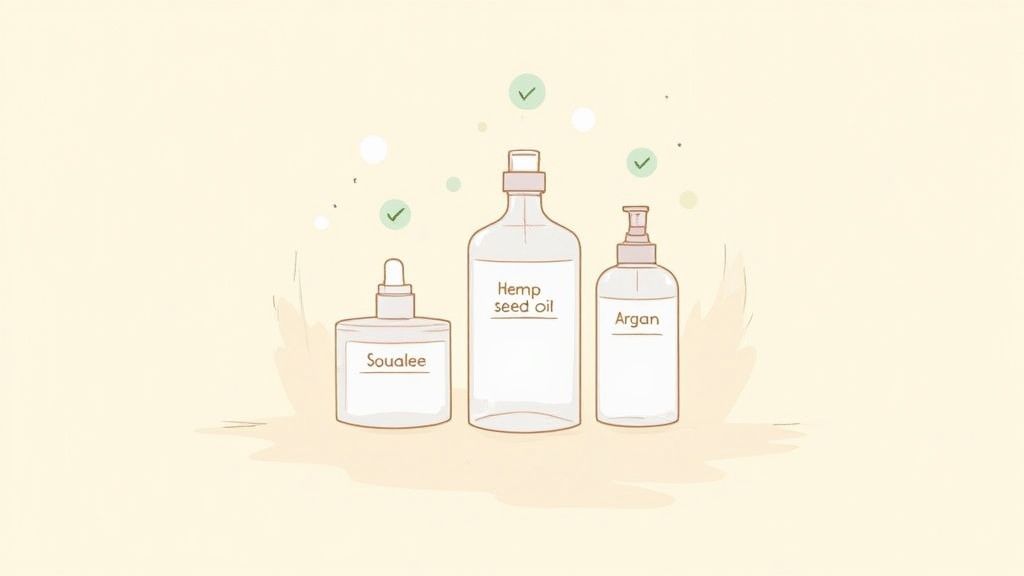
Here are a few fantastic non-comedogenic oils and butters to look for:
- Squalane Oil (Rating: 0): This stuff is amazing. It’s a lightweight, fast-absorbing oil that feels remarkably similar to your skin's own sebum. It delivers incredible moisture without that greasy feeling and is well-tolerated by just about everyone.
- Hemp Seed Oil (Rating: 0): For acne-prone skin, this oil is a powerhouse. It's rich in linoleic acid, which helps get sebum production under control and can reduce inflammation, all with zero risk of clogging pores.
- Argan Oil (Rating: 0): Often called "liquid gold," argan oil is loaded with antioxidants and vitamin E. It nourishes skin deeply but is still light enough for daily use, even on your face.
- Sunflower Oil (Rating: 0-2): The key here is to look for high-linoleic varieties, as those are generally non-comedogenic. This version is light, gentle, and fantastic for supporting your skin’s natural protective barrier.
The Power of Biocompatible Ingredients
Going beyond just the numbers on a rating scale, the most effective routines are built around ingredients that are biocompatible. This just means they're easily recognized and used by your skin. This is where an ingredient like grass-fed tallow truly shines.
Tallow’s fatty acid profile is incredibly similar to our skin’s own oils. This unique compatibility means it sinks in quickly and gets to work delivering vital nutrients, all without suffocating the skin or leaving behind that greasy film that can lead to clogs.
This very concept is the heart of our simple, three-ingredient formulas at Wild Tallow. By centering our products on high-quality, grass-fed tallow, we offer deep, lasting moisture that supports your skin's natural barrier, letting you sidestep the entire minefield of the pore clogging ingredients list.
It’s clear people are catching on. The anti-acne cosmetics market is projected to skyrocket from $5.29 billion in 2024 to an estimated $12.65 billion by 2034. This wave is driven by savvy consumers who are actively avoiding top offenders like isopropyl palmitate (rated 5) and stearyl alcohol (rated 2-3). In the US, where 85% of people aged 12-24 struggle with acne, major brands are even reformulating products—slashing ingredients like coconut butter (rated 4) from 30% of their lotions down to under 10% and seeing sales for pore-clearing products spike as a result. You can dive deeper into the growth of the anti-acne market here.
This huge market shift points to one simple truth: people want clean, intelligently formulated products that work. By focusing on biocompatible ingredients like tallow, you can build a routine that not only prevents breakouts but actively promotes healthy, resilient skin. To see exactly how this works for breakout-prone complexions, check out our detailed guide on using tallow for acne-prone skin in our detailed guide.
Answering Your Top Questions About Pore-Clogging Ingredients
Once you start looking at ingredient labels, it's like opening Pandora's box. Suddenly, a dozen questions pop up. It can feel confusing, but don't worry. Let's walk through some of the most common head-scratchers so you can feel totally in control of what you put on your skin.
This is where we get into the real-world nuances that go beyond a simple pore-clogging ingredients list.
Does an Ingredient's Position on the Label Really Matter?
Absolutely. If you only remember one thing from this guide, let it be this. Ingredient lists are always written in descending order of concentration, meaning the first five to seven ingredients do almost all the heavy lifting in the formula.
Think of it like a recipe: if the first ingredient is a cup of flour and the last is a pinch of salt, you know the flour is the real star of the show. It's the exact same with skincare. A high-risk ingredient like Coconut Oil (rated 4) sitting in the number one or two spot is a major red flag. If that same oil is listed last, its concentration is likely less than 1% and far less of a threat.
As a rule of thumb, be extremely cautious if you spot a known pore-clogger in the top third of the ingredients. Its prime position gives it a much greater chance to cause trouble.
Can Products Labeled 'Non-Comedogenic' Still Cause Breakouts?
Yes, and this is a huge one. This single marketing claim trips up so many people. The term "non-comedogenic" isn't regulated by the FDA, which means a company can slap it on a label without having to provide a shred of scientific proof.
It’s almost always a marketing buzzword, not a guarantee of clear skin.
More importantly, everyone's skin is unique. A product that works beautifully for 99% of people might just contain that one specific ingredient that your skin hates. The best strategy is always to learn your personal triggers and patch-test new products. That will serve you far better than blindly trusting a claim on the front of a bottle.
Are Natural or Organic Ingredients Automatically Safe for Acne-Prone Skin?
Not even close. This is probably one of the biggest myths in skincare today. "Natural" has absolutely nothing to do with "non-comedogenic." In fact, some of the most aggressive pore-cloggers are completely natural, plant-based ingredients.
Just look at a few popular examples:
- Coconut Oil: Famous for its benefits, but it carries a comedogenic rating of 4.
- Wheat Germ Oil: This one's a 5, the highest rating possible.
- Cocoa Butter: Another fan-favorite moisturizer that's rated a 4 and is notorious for causing facial breakouts.
These ingredients can be fantastic for the body, but on acne-prone facial skin, they can be a total disaster. The takeaway here is to judge an ingredient by its actual properties and comedogenic rating, not by whether it came from a lab or a plant.
If I Have Dry Skin, Should I Still Worry About Pore-Clogging Ingredients?
While those with oily, acne-prone skin have to be the most careful, dry skin isn't totally exempt. At the end of the day, you still have pores, and those pores can still get blocked.
Heavy, waxy ingredients can trap dead skin and bacteria, leading to the occasional pimple. But for dry skin, this often shows up as milia—those tiny, hard white bumps that form when keratin gets trapped under the surface.
You might find your dry skin does just fine with moderately comedogenic moisturizers like Shea Butter (rated 0-2), because the deep hydration benefits outweigh the minimal risk. Even so, it’s still smart to steer clear of the big offenders (anything rated 4 or 5). Keeping your pores clear helps your skin function at its best, and a clear complexion is a sign of happy, balanced skin, no matter your type.
At Wild Tallow Skincare, we believe in radical simplicity. Our formulas are built around 100% grass-fed tallow and just two other food-grade ingredients, completely sidestepping the complex and confusing world of potential pore-cloggers. Experience the difference of a truly minimal, biocompatible routine by exploring our collection of tallow-based skincare.